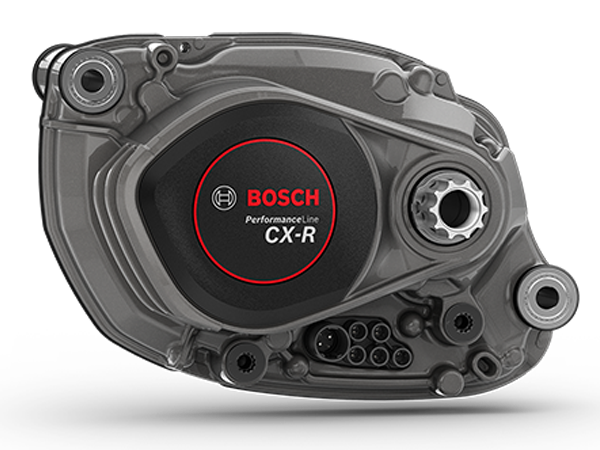
Bosch CX-R
At its core, the CX-R is a fifth-generation Bosch CX with two subtle differences: Bosch fits it with a titanium axle and ceramic bearings. This also accounts for the slightly lower weight, which the manufacturer states as 2.7 kg. The performance figures remain unchanged. Its real unique selling point is the Race assist mode, which is exclusive to this motor. However, its strengths lie mainly in its particular response behavior, and that can only be reproduced to a limited extent on the test bench.
Battery System & Chargers
🔋 Battery System
| Model | Capacity | Weight | Energy Density | Dimensions | Mounting |
|---|---|---|---|---|---|
| Powertube 800 | 800 Wh | 3.9 kg | 205 Wh/kg | 424 x 77 x 71 | Internal |
| Powertube 750 | 750 Wh | 4.3 kg | 174 Wh/kg | 484 x 84 x 65 | Internal |
| Powertube 625 | 625 Wh | 3.6 kg | 174 Wh/kg | 415 x 84 x 65 | Internal |
| Powertube 600 | 600 Wh | 3 kg | 200 Wh/kg | 424 x 71 x 67 | Internal |
| Powertube 540 | 540 Wh | 3 kg | 180 Wh/kg | 424 x 71 x 67 | Internal |
| Powertube 500 | 500 Wh | 3 kg | 167 Wh/kg | 345 x 84 x 65 | Internal |
| Compactube 400 | 400 Wh | 2 kg | 200 Wh/kg | 352 x 57 x 75 | Internal |
| Powerpack 800 Frame | 800 Wh | 3.9 kg | 205 Wh/kg | 345 x 95 x 100 | Frame |
| Powerpack 545 Frame | 545 Wh | 3 kg | 182 Wh/kg | 338 x 93 x 81 | Frame |
| Powerpack 400 Frame | 400 Wh | 2.2 kg | 182 Wh/kg | 336 x 91 x 62 | Frame |
| Powerpack 500 Rack | 500 Wh | 2.8 kg | 179 Wh/kg | 376 x 122 x 64 | Rack |
| Powerpack 400 Rack | 400 Wh | 2.7 kg | 148 Wh/kg | 376 x 122 x 64 | Rack |
➕ Range Extender Available
| Model | Capacity | Weight | Dimensions |
|---|---|---|---|
| Powermore 250 | 250 Wh | 1.5 kg | 200 x 88 x 75 |
🔌 Chargers
| Model | Current | Dimensions |
|---|---|---|
| Standard Charger | 4 A | 190 x 90 x 50 |
| Compact Charger | 2 A | 167 x 76 x 45 |
Power Characteristics
Shows how much power the motor delivers for a given rider input. The value shown is pure motor power, adjusted for input and drivetrain losses.
Input vs. Output: Bosch CX-R
In Race mode, the CX-R gets off to a spirited start: At just 50 watts of rider input, we already measure around 350 watts of motor output, and at 100 watts it is already delivering around 530 watts. It reaches its plateau of around 700 watts from about 140 watts of rider input and then holds it almost constant up to 300 watts. With a peak output of around 710 watts, it sits just below the CX 5 at around 730 watts and roughly level with the Specialized 3.1. Front-runners such as the Mahle M40 or the Avinox motors clearly pull ahead of it.
Power vs. Torque: Bosch CX-R
🧮Power (solid, left axis) and the derived torque (dotted, right axis) across the cadence range. Torque peaks at low cadence and drops as rpm rises — even when power output stays constant.
Unterstützungsstufen
Comparison of different assistance modes (e.g. Eco, Trail, Turbo).
Profile: Bosch CX-R
We measured the exclusive Race mode. Its assistance factor drops markedly as rider input increases: At 100 watts of rider input it sits at around 530%, at 250 watts only at around 280%, because by then the motor has already reached its power plateau. The real strengths of Race mode, however, lie in its response behavior, which shows itself out on the trail rather than on the test bench.
Cadence Behavior
Shows the optimal RPM range.
Power vs. Cadence (Relative (%))
At a constant 30 Nm of rider torque, the CX-R's output rises steadily with cadence until it reaches its plateau of around 710 watts at about 80 rpm. It then holds this level up to 120 rpm without any notable fluctuations, even gaining a touch right at the end. This puts it on par with the CX 5 and the Gobao P100, while the Mahle M40 or Specialized 3.1, for example, deliver more power in this scenario. Either way, its behavior is highly predictable.
Thermal Performance
Shows power output performance over 15/20 minutes under constant full load.
20 min
Thermally, the CX-R behaves just like its base model: During the first five minutes, output stays practically stable at around 98%, after which derating noticeably kicks in. After ten minutes, around 88% remains, and after 20 minutes it levels off at about 79% of its initial output, exactly the same figure as the CX 5. So the titanium axle and ceramic bearings apparently make no difference to heat build-up. Motors like the Gobao P100 or Avinox M1 retain significantly more power over the distance at around 96%.