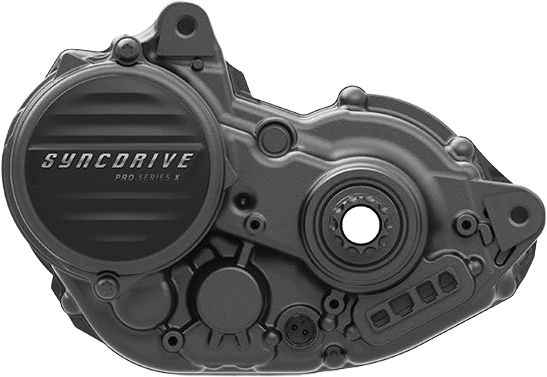
Giant SyncDrive Pro 3X
In its latest iteration, Giant's proprietary SyncDrive drive system continues to rely on Yamaha motor hardware. Compared to its predecessor, the motor has shed around 300 g of weight and, according to the spec sheet, gained a substantial boost in power and torque. The system voltage remains at 36 V for the SyncDrive Pro 3X variant, whereas the SyncDrive Pro 3 utilizes a 48 V system.
Battery System & Chargers
🔋 Battery System
| Model | Capacity | Weight | Energy Density | Dimensions | Mounting |
|---|---|---|---|---|---|
| EnergyPak Smart 800 | 811 Wh | 4.1 kg | 198 Wh/kg | n/a | Internal |
| EnergyPak Smart 625 | 621 Wh | 3.9 kg | 159 Wh/kg | n/a | Internal |
➕ Range Extender Available
| Model | Capacity | Weight | Dimensions |
|---|---|---|---|
| EnergyPak Plus 200 | 200 Wh | 1.1 kg | n/a |
🔌 Chargers
| Model | Current | Dimensions |
|---|---|---|
| Smart Charger 6A | 6 A | n/a |
Power Characteristics
Shows how much power the motor delivers for a given rider input. The value shown is pure motor power, adjusted for input and drivetrain losses.
Input vs. Output: Giant SyncDrive Pro 3X
Looking at the power curve, there is a bit of initial disappointment: the Giant SyncDrive Pro 3X falls far short of the advertised 800-watt maximum output. In our testing scenario, it maxed out at around 500 watts. The support is tuned sportily, requiring decent rider input before the new SyncDrive truly wakes up. The maximum assistance factor we measured was 320%.
Power vs. Torque: Giant SyncDrive Pro 3X
🧮Power (solid, left axis) and the derived torque (dotted, right axis) across the cadence range. Torque peaks at low cadence and drops as rpm rises — even when power output stays constant.
Unterstützungsstufen
Comparison of different assistance modes (e.g. Eco, Trail, Turbo).
Profile: Giant SyncDrive Pro 3X
The tuning of the individual modes is straightforward, with differences that are clearly noticeable and measurable on the trail. Furthermore, all assistance levels feature a linear delivery with a fixed support factor.
Cadence Behavior
Shows the optimal RPM range.
Power vs. Cadence (Relative (%))
The cadence curve reveals very stable and predictable behavior from the new Giant motor. It hits its peak output between 70 and 80 rpm and maintains it consistently up to roughly 135 rpm. Unfortunately, higher cadences fail to extract the promised peak performance, with output remaining capped at around 500 watts.
Thermal Performance
Shows power output performance over 15/20 minutes under constant full load.
20 min
The thermal behavior of the compact SyncDrive motor is rather unique. Thermal derating kicks in after about 10 minutes, exhibiting two notable characteristics: First, the motor housing temperature was comparatively low at just 75°C. Second, the derating pattern itself is unusual: power output fluctuates fairly abruptly by around 10% before settling at approx. 90% of maximum output. After roughly 15 minutes, a similar oscillation occurs between 90% and 80% of peak power.